Top 10 USB Interface Types You Need to Know for Your Devices
In an increasingly interconnected world, the technology that links our devices is more critical than ever. One key component in this connectivity landscape is the USB interface, which has evolved from its initial design to accommodate an expanding range of devices and functionalities. According to a recent industry report by the USB Implementers Forum, over 10 billion USB ports are shipped annually, reflecting a robust surge in demand for versatile data transfer and power solutions. As technology advances, the importance of understanding various USB interface types becomes essential for consumers and professionals alike.
With the rise of smart devices, laptops, and peripherals, the utilization of different USB interface types plays a crucial role in ensuring compatibility and efficiency in device performance. Data from market analysis indicate that USB-C has rapidly gained popularity, marking a significant shift away from traditional interfaces due to its ability to support higher power delivery and faster data rates. Furthermore, with the increasing adoption of standards like USB 3.2 and USB4, knowledge of these diverse USB interfaces is vital for making informed decisions that profoundly impact user experience and device functionality.

Overview of USB Interface Types and Their Importance
The USB interface has become an essential part of modern technology, facilitating communication and power supply between various devices. Understanding the different types of USB interfaces is crucial for optimizing performance and compatibility. According to a report by the USB Implementers Forum, the USB market is expected to grow significantly, reaching approximately $22 billion by 2026. This growth underscores the importance of staying informed about the evolving USB standards, which cater to diverse applications—from charging smartphones to connecting high-speed peripherals.
Among the numerous USB interface types, USB-A, USB-B, and USB-C stand out due to their widespread adoption. USB-C, in particular, has gained momentum as it supports faster data transfer rates of up to 40 Gbps and higher power delivery capabilities, delivering up to 100 watts. Moreover, a study published by IEEE indicates that USB-C adoption in laptops and smartphones is projected to surpass 85% by 2025, highlighting its critical role in the interconnected ecosystem of devices. Awareness of these types and their functionalities not only enhances user experience but also future-proofs device compatibility as technology continues to evolve.
Top 10 USB Interface Types You Need to Know for Your Devices
Understanding USB 1.0 to USB 3.2: Evolution and Standards
The evolution of USB technology has significantly transformed how we connect and communicate with various devices. Starting with USB 1.0, introduced in 1996, the standard offered a modest data transfer rate of 1.5 Mbps, gradually evolving into USB 3.2, which can achieve speeds up to 20 Gbps. According to a recent report by the USB Implementers Forum, the adoption of USB technology has reached over 10 billion devices worldwide, showcasing its integral role in consumer electronics.
As USB standards progressed, the introduction of USB 2.0 in 2000 marked a significant milestone by increasing the data transfer rate to 480 Mbps, making it suitable for a broader range of peripherals. USB 3.0, launched in 2008, provided a leap in performance, enabling speeds of up to 5 Gbps. This marked a critical shift, especially for high-bandwidth devices like external hard drives and high-resolution cameras. A survey conducted by Research and Markets predicts that the USB interface market will continue to grow, driven by increasing demand for faster data transfer and connectivity solutions in both personal and enterprise sectors. The future of USB looks promising, with USB4 on the horizon, intended to unify the USB ecosystem and further enhance speed and versatility.
Comparative Features of USB-C and USB-A Interfaces
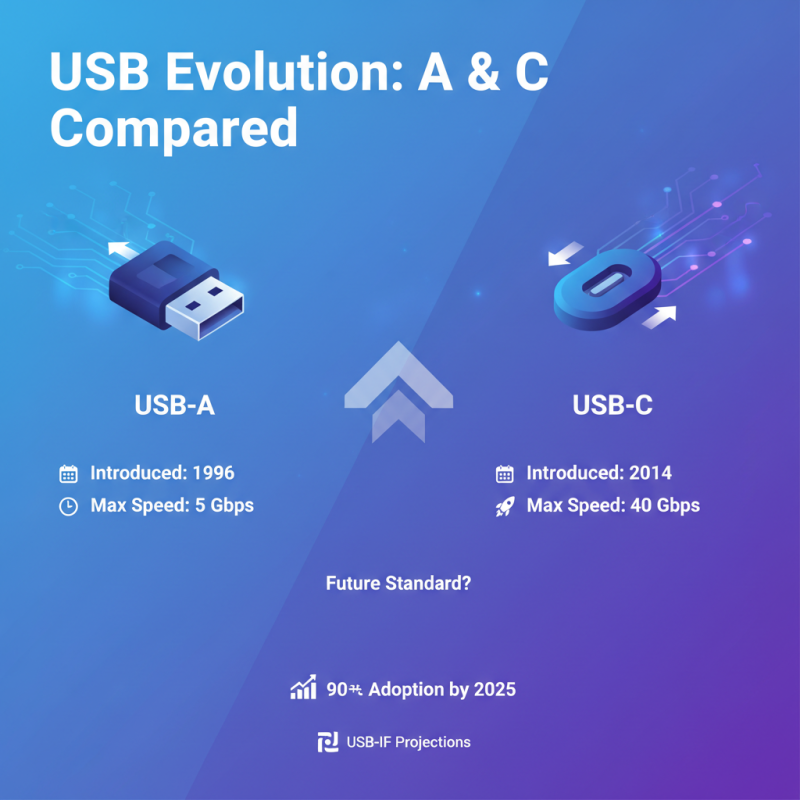
When comparing USB-C and USB-A interfaces, it’s crucial to understand their distinctive features and the impact they have on modern device connectivity. USB-C, introduced in 2014, has quickly become the standard for many devices due to its versatile functionality and superior capabilities. According to the USB Implementers Forum, the adoption rate of USB-C devices is projected to reach over 90% by 2025, indicating a significant shift in consumer preferences and device design. USB-C supports faster data transfer rates, with the potential for speeds up to 40 Gbps, vastly outpacing the maximum of 5 Gbps offered by USB-A.
In terms of power delivery, USB-C supports up to 100 watts, making it suitable for a wide range of devices, from smartphones to laptops. This contrasts sharply with USB-A, which can typically provide a maximum power output of only 2.5 watts to 12 watts, depending on the specification version. The flexibility of USB-C to connect various devices through a single port adds to its appeal, catering to the increasingly mobile and streamlined nature of technology. As a result, many industry analysts suggest that the transition to USB-C is not just a trend but a fundamental shift in how we connect and power our devices in an ever-evolving tech landscape.
Exploring USB Power Delivery and Charging Capabilities
USB Power Delivery (USB PD) is a versatile charging standard that significantly enhances the power transfer capabilities of USB interfaces. It enables devices to communicate and negotiate the amount of power they require, allowing for faster charging and efficient energy management. Unlike traditional USB, which limits output to a specific wattage, USB PD can deliver up to 100 watts of power, making it suitable for a wide range of devices, from smartphones to laptops.
When considering the benefits of USB Power Delivery, it's essential to ensure compatibility among your devices. Many modern gadgets support USB PD, but to maximize the charging experience, both the charger and the cable must also meet the USB PD specifications. It’s advisable to use certified cables that can handle higher wattage and provide protection against overheating and overcurrent for safety.
**Tips:** To make the most out of USB Power Delivery, check that your devices are indeed compatible with USB PD. Consider investing in a multi-port USB PD charger to charge multiple devices simultaneously without sacrificing charging speed. Always keep your cables in good condition; frayed or damaged cables can hinder performance and increase the risk of malfunction. By being mindful of these factors, you can leverage the full potential of USB Power Delivery capabilities to enhance your device charging routine.
Top 10 USB Interface Types You Need to Know for Your Devices - Exploring USB Power Delivery and Charging Capabilities
| USB Type |
Max Data Transfer Rate |
Power Delivery (PD) |
Connector Size |
Common Uses |
| USB 2.0 |
480 Mbps |
Up to 2.5W |
Standard |
Keyboards, Mice, Flash Drives |
| USB 3.0 |
5 Gbps |
Up to 4.5W |
Standard |
External Hard Drives, Webcams |
| USB 3.1 |
10 Gbps |
Up to 100W |
Standard |
High-Performance Storage, Monitors |
| USB 3.2 |
20 Gbps |
Up to 100W |
Standard |
4K Monitors, Advanced Gaming |
| USB4 |
40 Gbps |
Up to 100W |
Standard |
Docking Stations, High-Speed Devices |
| USB-C |
Varies (up to 40 Gbps) |
Up to 240W |
Compact |
Smartphones, Laptops, Chargers |
| USB Micro |
480 Mbps |
Up to 2.5W |
Small |
Smartphones, Portable Devices |
| USB Mini |
480 Mbps |
Up to 2.5W |
Medium |
Digital Cameras, Older Devices |
| USB A |
Varies (up to 10 Gbps) |
Up to 4.5W |
Standard |
Computers, Hubs |
| USB B |
Varies |
Low (varies) |
Standard |
Printers, Scanners |
Future Trends: The Role of USB Interfaces in New Technologies
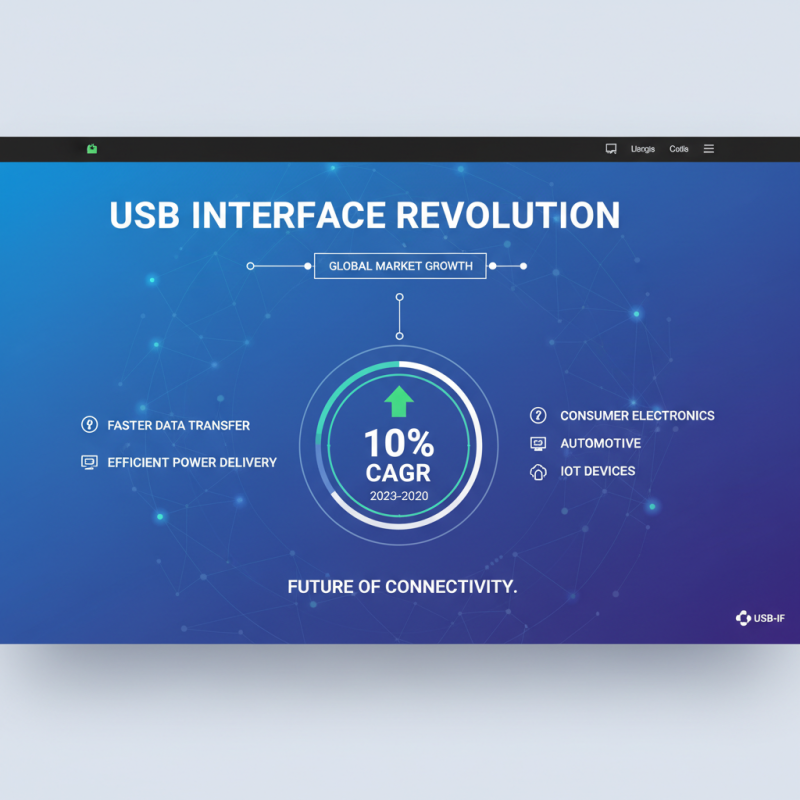
The emergence of USB interfaces has revolutionized how devices connect and communicate, significantly influencing future technologies. According to a recent report by the USB Implementers Forum, the global USB market is projected to witness a robust compound annual growth rate (CAGR) of 10% from 2023 to 2030. This growth is driven by the increasing demand for faster data transfer rates and more efficient power delivery in consumer electronics, automotive, and IoT devices. As devices become more interconnected, USB interfaces are evolving to meet the needs of high-speed data transfer and versatile connectivity that modern applications require.
In particular, the transition towards USB4, which offers maximum throughput of 40 Gbps, is set to enhance data-intensive applications like 4K video streaming and large file transfers. The adoption of USB4 is also reinforced by its compatibility with Thunderbolt 3, promoting seamless integration across diverse hardware ecosystems. Industry analysts predict that as cloud computing and AI technologies become more prevalent, the reliance on advanced USB interface types will continue to grow, enabling greater efficiency and user experience. By aligning USB technology with emerging fields such as augmented reality and smart home devices, the potential to create a more interconnected world is within reach, showcasing USB’s pivotal role in future technological advancements.
 008613968780263

 CONTACT NUMBER
 CONTACT