Top 10 Types of Fiber Optic Connectors You Should Know About?
In the world of telecommunications, the right Fiber Optic Connector is crucial. According to industry expert Dr. Emily Chen, "Choosing the right connector can make or break a network's performance." Her insights highlight the importance of understanding fiber optic connectors.
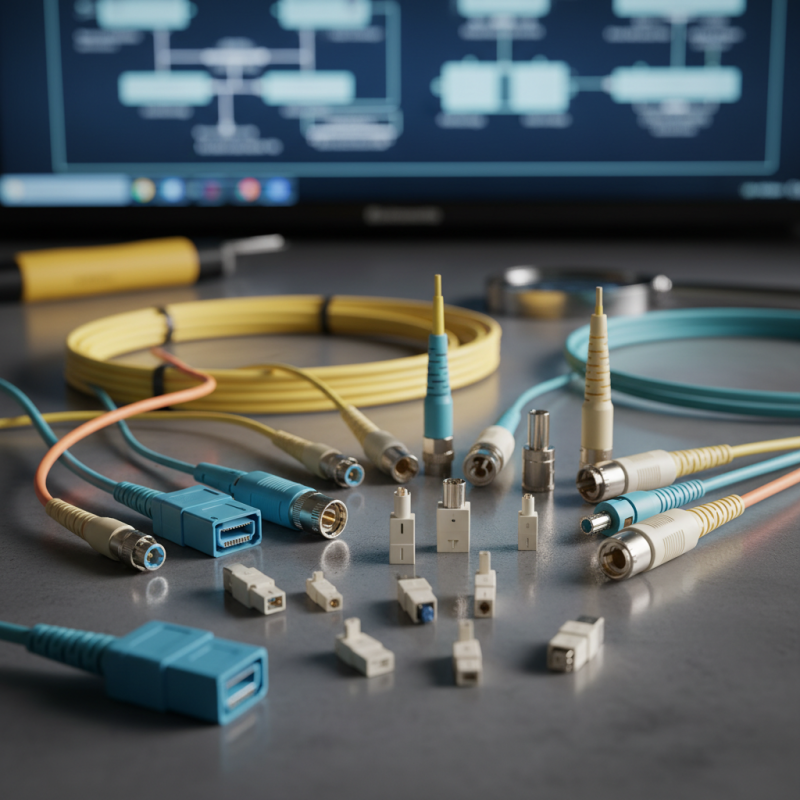
Fiber optic connectors facilitate the seamless transmission of light signals within a network. With various types available, it's vital to know their distinct features. For instance, SC, LC, and ST connectors each serve unique roles in connectivity. The right choice can enhance bandwidth and reduce signal loss.
Yet, many overlook the nuances of these connectors. Mistakes in selection or installation could lead to costly network downtime. It prompts us to reflect on our choices carefully. Awareness of these connectors is essential for anyone involved in network infrastructure. Understanding their types is not just beneficial; it's necessary.
Overview of Fiber Optic Connectors and Their Importance
Fiber optic connectors are crucial in modern communication systems. They enable the connection and disconnection of fiber cables, ensuring high-speed data transmission. According to a report by Research and Markets, the global fiber optic connector market is expected to grow at a CAGR of around 10% from 2021 to 2026. This highlights their growing importance in various sectors.
Different types of fiber optic connectors are available, such as SC, LC, and MPO. Each type serves specific purposes and applications. For example, LC connectors are popular in high-density environments due to their small size. However, the design of some connectors can lead to issues like misalignment and signal loss. A study by CRU Group found that even minor connector misalignments can cause up to 20% loss in signal quality. Ensuring proper installation and maintenance is critical for optimal performance.
Moreover, the choice of connector affects overall network performance. Data from the Fiber Optics Association indicates that over 70% of network failures can be traced back to poor connections. Investing in quality connectors can mitigate these risks. It’s essential to assess your needs carefully.
Top 10 Types of Fiber Optic Connectors You Should Know About
| Connector Type |
Description |
Application |
Advantage |
| SC Connector |
Square connector with a push-pull design. |
Telecommunications |
Easy to connect and disconnect. |
| LC Connector |
Compact connector, suitable for high-density applications. |
Data centers |
Space-saving design. |
| FC Connector |
Connector with a screw-on mechanism. |
Fiber optic telecommunication |
Low loss and highly effective. |
| ST Connector |
A bayonet-style connector with a twist-on design. |
Multimode networks |
Reliable and easy to use. |
| MTP/MPO Connector |
Multi-fiber connector used in high-density applications. |
Data centers |
High-density connectivity. |
| E2000 Connector |
Advanced connector with a protective cap. |
Telecom and data networks |
High performance and low insertion loss. |
| LC/APC Connector |
Low loss connector with an angled end face. |
High-speed networks |
Minimized back reflection. |
| SC/APC Connector |
SC connector with an angled end face. |
Broadband networks |
Reduced signal loss. |
| D4 Connector |
Used for multi-fiber applications with a locking mechanism. |
Telecom applications |
Secure connection. |
| VF-45 Connector |
Compact design with a unique handling ease. |
Fiber optic testing |
Fast connection and disconnection. |
Types of Fiber Optic Connectors: An In-Depth Look
Fiber optic connectors are pivotal in modern communication systems. These connectors ensure efficient data transmission over long distances. An in-depth look at various types reveals their unique features and applications. According to industry data, around 80% of networks rely on fiber optics for high-speed internet.
SC connectors are among the most common types. They are push-pull connectors, which facilitate quick connections. Meanwhile, LC connectors are preferred in high-density environments due to their compact size. Interestingly, their duplex design helps save space while maintaining performance. Issues can arise with misalignment, which leads to signal loss.
MPO/MTP connectors are vital in data centers. They can connect multiple fibers at once. This efficiency is crucial, especially as data demands increase. However, these connectors can be complicated. Proper training is essential for installation to prevent errors. A small mistake can lead to significant data transmission issues. Overall, understanding these connectors is crucial for anyone involved in network infrastructure improvements.
Key Features and Specifications of Common Connectors
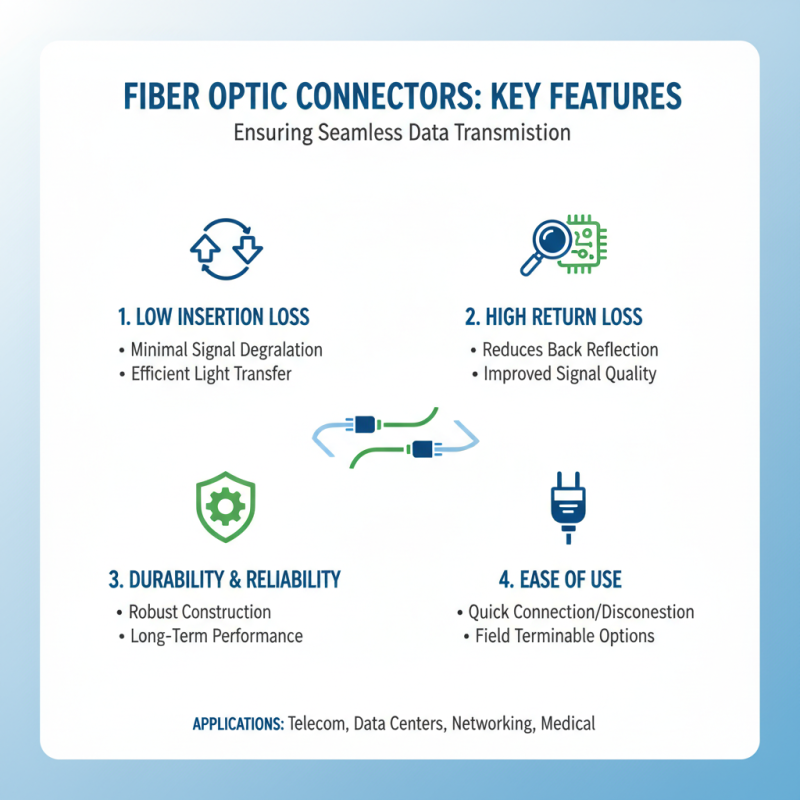
Fiber optic connectors play a crucial role in ensuring the integrity of data transmission. They enable seamless communication in various applications, from telecommunications to data centers. Understanding their key features can help you choose the right connector for your needs.
One popular type is the LC connector. It is compact and offers low loss. According to the Fiber Optic Association, LC connectors typically have a loss of 0.2 dB or less. They are ideal for high-density applications. However, their small size can make installation tricky for some technicians. On the other hand, SC connectors are known for their durability and easy handling. Data from the Telecommunication Industry Association states that SC connectors often provide reliable performance in harsh conditions. But their bulkier design can take up more space.
MTP/MPO connectors are gaining traction due to their ability to connect multiple fibers at once. Reports suggest that they can simplify complex installations. Yet, managing these connectors can be challenging for those unfamiliar with them. This complexity can lead to issues if not handled correctly, particularly in high-speed environments. Opting for the right connector involves not just considering performance but also the practicality of installation and management. Balancing these factors can be daunting, yet essential for successful deployment in fiber optic systems.
Applications and Use Cases for Different Fiber Connectors
Fiber optic connectors play a crucial role in modern communication. These connectors link various components in a fiber optic network. Different types of connectors fit specific applications and use cases. For instance, LC connectors are widely used in data centers due to their compact size. They save space while providing reliable connections.
SC connectors, on the other hand, are popular for their low insertion loss. They are commonly found in telecom applications. ST connectors, with their bayonet-style locking mechanism, are ideal for environments where quick disconnection is necessary. However, this ease of use can lead to accidental disconnections if not properly managed.
Understanding the appropriate use cases for each connector is important. Some connectors may not perform optimally in certain situations. Awareness of these details can lead to better network performance. The choice of connector can impact installation and maintenance costs. Therefore, evaluating the specific needs of your project is essential for success.
Future Trends in Fiber Optic Connector Technology
Future Trends in Fiber Optic Connector Technology
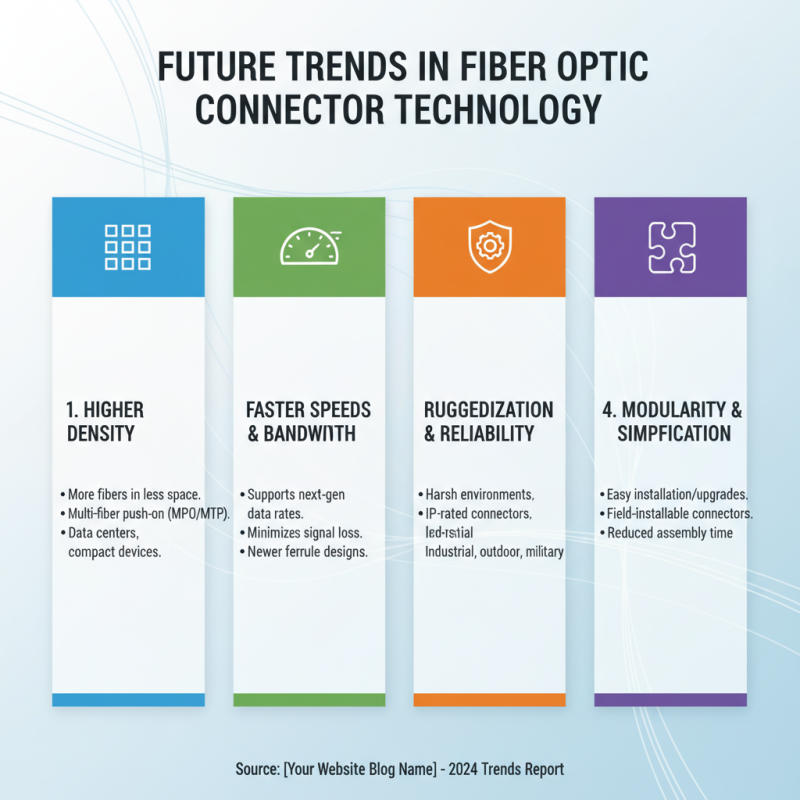
The fiber optic connector landscape is evolving rapidly. Recent reports suggest that the global fiber optic connector market is expected to grow at a CAGR of 10.1% between 2022 and 2030. This presents exciting opportunities for manufacturers and users alike. One clear trend is the shift towards smaller, more efficient connectors that save space and reduce signal loss.
Emerging technologies such as MPO and MXC connectors are paving the way for higher-density solutions. These types enable the seamless integration of fiber connections in data centers, meeting the increasing demand for bandwidth. However, deploying these connectors requires careful planning and quality assurance to avoid connectivity issues. Consider focusing on training for your installation teams.
Tip: Stay updated on the latest connector specifications to make informed decisions for future projects.
Moreover, the rise of smart technologies, like IoT and 5G, drives innovations in fiber optics. The connectors must handle rapid data growth while maintaining reliability. An increasing emphasis on sustainability is prompting companies to explore eco-friendly materials and manufacturing processes.
Tip: Regularly evaluate the environmental impact of your fiber optic connectors. Balancing performance and sustainability is crucial as the industry progresses.
 008613968780263

 CONTACT NUMBER
 CONTACT