Leave Your Message

10 Best Metal Radiator Manufacturers for Global Buyers

Global buyers comparing Metal Radiator manufacturers need more than a polished catalog. A radiator must suit its heat load, operating environment, installation space, and maintenance plan. Small details matter. Connections, fin spacing, wall thickness, and coating quality can affect fit and long-term performance.

This guide introduces ten manufacturers for buyers to evaluate across international markets. It considers product range, material options, customization, production capacity, and technical support. A supplier’s stated capabilities should be checked against drawings, test reports, and project requirements. Ask for evidence of relevant quality processes, consistent dimensions, and suitable corrosion protection. These checks help distinguish documented performance from broad marketing claims. Fit comes first.

The right choice depends on the application. Residential heating projects may prioritize quiet operation, finish options, and straightforward installation. Industrial buyers may focus on pressure ratings, temperature limits, robust construction, and replacement availability. Request clear specifications and confirm which details are standard or made to order. Lead times, shipping arrangements, warranty terms, and after-sales support also deserve careful review. A familiar brand is not automatically the best fit, and a low price can hide costs in adaptation or service. Some comparisons remain imperfect because suppliers publish different levels of technical detail. Use this shortlist as a starting point, then verify every option against your own project’s needs.
10 Best Metal Radiator Manufacturers for Global Buyers

What Defines a Leading Metal Radiator Manufacturer?

What Defines a Leading Metal Radiator Manufacturer?

A leading metal radiator manufacturer does more than shape steel or aluminum into panels. It can explain how material grade, wall thickness, weld quality, and surface treatment affect heat output and service life. Ask for documented thermal test results and inspection records, not broad claims. Reliable suppliers can discuss operating pressure, temperature limits, corrosion risks, and installation conditions. Their engineering team should review drawings and flag mismatched connections before production begins. This is practical expertise.

Tips: Request a sample datasheet, dimensional tolerances, and a written quality-control plan. Check how the supplier handles defects, spare parts, and delivery changes. A polished catalog is useful, but it cannot replace traceable test evidence. Confirm project-specific details in writing.

Consistency matters across production batches. Look for material checks, weld inspections, leak testing, and final dimensional checks, with records linked to production lots. Ask whether testing reflects real working conditions; a pressure test alone does not prove thermal performance. Global buyers also need clear packaging specifications, export documents, and realistic lead times. Communication counts too. Answers should be specific, even when the supplier needs to verify a detail. No factory is perfect, and a delayed clarification can reveal more than a confident promise. Compare suppliers against your technical requirements, then weigh price against documented performance and support.
Key Criteria for Evaluating Global Radiator Suppliers

For global buyers, supplier evaluation should begin with the radiator’s material, construction, and test evidence—not the catalogue photo. The World Steel Association reported 1,892.2 million tonnes of crude steel production in 2023, but abundant supply does not guarantee consistent product quality. Ask for material specifications, batch traceability, and documented pressure and leak-test procedures. Numbers matter.

Check whether the manufacturer can match your system’s operating pressure, water temperature, connection layout, and corrosion conditions. The International Energy Agency’s Buildings report notes that buildings account for about 30% of global final energy consumption. Radiators are only one part of that picture, so request output ratings under stated test conditions rather than relying on broad efficiency claims.

Also review production capacity, lead times, export packaging, warranty terms, and how defects are handled. A low quote can still be costly.

Tips: Request a recent test report and a sample unit. Inspect welds, coating coverage, and threaded ports closely. Confirm the ratings match your project’s actual system. Check the details. Paperwork helps, but it cannot reveal every production variation; an independent inspection may be worthwhile for a large order.

Profiles of 10 Notable Metal Radiator Manufacturers

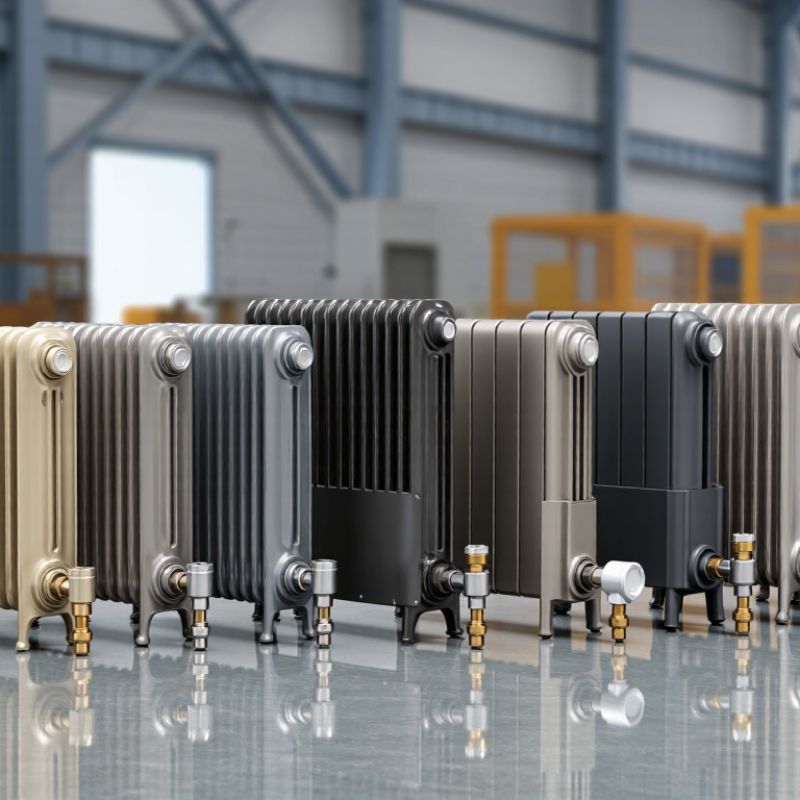
Global buyers can compare metal radiator manufacturers by engineering focus, materials, and production scale. These ten profiles describe distinct supplier strengths, not a verified ranking. One profile is a high-volume steel-panel producer, suited to standard sizes and repeat orders. Another specializes in aluminum radiators, where low weight and quick heat response matter. A third builds cast-iron units with thick sections and traditional detailing. A fourth focuses on stainless-steel models for humid interiors. A fifth offers custom fabrication, shaping tubes and headers to project drawings.

The sixth serves commercial projects with oversized heat exchangers and documented pressure tests. The seventh makes compact bathroom radiators, balancing towel clearance with heat output. The eighth integrates smart valves and factory-tested controls. The ninth supports private-label production, though buyers should check design ownership and change procedures. The tenth emphasizes export packaging, including corner guards and moisture barriers. Ask suppliers for material certificates, coating data, dimensional tolerances, test conditions, and warranty terms. Compare output at the same water temperatures; catalog figures can mislead. The comparison is imperfect: custom work and standard production rarely share the same cost basis. Small details matter. Inspect welds, threads, and mounting brackets on a sample. A polished brochure is not proof.

Typical Thermal Conductivity of Radiator Metals

A material comparison relevant to radiator design and manufacturing. Values are approximate thermal conductivity at room temperature; actual performance varies by alloy and product design.

Comparing Product Range, Certifications, and Global Reach

When comparing metal radiator manufacturers, look beyond catalogue size. A broad range may include steel panel, aluminium, and cast-iron models, but availability can vary by market. Check dimensions, heat output, connection positions, and operating pressure against the project specification. Ask for technical data sheets and test records, not just promotional claims. Details matter. A certificate is useful only when its scope covers the product and factory being quoted.

Tips: Request certification documents, warranty terms, and sample installation guidance. Compare lead times for the exact model, finish, and quantity. Confirm whether replacement valves or other compatible parts can be supplied later. Small omissions can cause delays.

Global reach involves more than shipping to many countries. Buyers should check export packaging, documentation support, local distributor coverage, and access to spare parts. Ask how damage claims are handled and whether production schedules can accommodate repeat orders. These answers reveal practical experience. Still, comparisons are not perfectly tidy: one supplier may publish clearer data while another offers a better fit for a specific project. Record the same criteria for each candidate, then verify key claims directly before ordering.

10 Best Metal Radiator Manufacturers for Global Buyers – Comparing Product Range, Certifications, and Global Reach

How to read this table: Company and brand names are omitted. The rows describe established metal-radiator manufacturer and supplier categories, not rankings of named companies. Standards and regulatory requirements depend on the product, market, and model; confirm applicable documentation with each supplier.

Manufacturer category Typical metal radiator range Common materials and formats Relevant standards or compliance checks Global reach considerations Often suited to
Steel panel radiator producer Single-, double-, and multi-panel hydronic radiators; convector-fin designs are common. Pressed and welded steel panels, usually supplied with painted finishes. Check EN 442 performance testing and declarations where applicable; verify operating pressure, heat-output data, and market-specific product documentation. Shipping dimensions, packaging protection, connection standards, and local importer requirements can affect international supply. Residential and light-commercial hydronic heating projects.
Steel tubular radiator producer Column-style radiators in a range of heights, widths, and section configurations. Welded steel tubes or columns, with sectional or fixed-format designs. Confirm applicable EN 442 testing, declared heat output, pressure limits, and corrosion-protection details. Check available connection options, dimensional tolerances, and replacement-part availability in destination markets. Renovations, traditional interiors, and projects requiring configurable radiator dimensions.
Designer steel radiator producer Decorative vertical, horizontal, sculptural, and custom-finish hydronic models. Steel plate, tube, or profile constructions; finish options vary by supplier. Request tested heat-output figures for the exact size and configuration; check coating specifications and relevant market conformity documentation. Custom finishes and non-standard dimensions may affect lead times, minimum order quantities, and replacement availability. Architect-led residential, hospitality, and interior-design projects.
Cast-iron radiator producer Sectional radiators, including traditional and reproduction designs. Cast-iron sections assembled into radiator units; painted finishes are common. Verify pressure ratings, connection details, tested or declared heat output, and applicable local installation rules. High product weight makes freight cost, handling, and secure packaging important for cross-border orders. Heritage restoration and projects prioritizing traditional appearance and thermal mass.
Aluminum sectional radiator producer Modular sectional radiators assembled to suit required output and room dimensions. Aluminum sections, commonly cast or extruded, joined into radiator assemblies. Check applicable performance testing, working-pressure limits, water-quality guidance, and compatibility with the heating system. Confirm the product is suitable for local system-water conditions and that matching sections and fittings can be sourced. Projects needing lightweight, modular radiators and flexible section counts.
Aluminum die-cast radiator producer Radiators made from cast aluminum elements, offered in fixed or modular configurations. Die-cast aluminum elements with coated or painted surfaces. Request model-specific heat-output and pressure data; verify applicable test methods and installation compatibility. Compare packaging, connection arrangements, and after-sales support in the destination country. Residential heating projects seeking cast-metal designs and relatively light product handling.
Metal electric radiator producer Electric panel, metal-bodied, and combination radiators, depending on the product line. Steel or aluminum bodies with electric heating elements and, in some models, electronic controls. Check electrical safety and EMC documentation for the target market, applicable energy-label rules, voltage, frequency, and plug or wiring requirements. Electrical specifications and conformity requirements differ by market; confirm local approvals before import. Rooms or buildings without a central hydronic heating connection.
Metal towel radiator producer Ladder-style and designer towel radiators for hydronic, electric, or dual-fuel applications. Steel or stainless-steel tubes and profiles; surface finishes vary. Verify the product's heating mode, pressure and temperature limits, electrical documentation where relevant, and applicable performance data. Confirm connection spacing, valve compatibility, finish durability, and availability of suitable accessories. Bathrooms, ensuites, and projects requiring both space heating and towel warming.
Commercial metal convector producer Wall-mounted convectors, cabinet units, and other metal-cased hydronic heating products. Steel or aluminum casings with internal heat-exchange elements; some designs use fans. Check declared thermal output, sound data for fan-assisted models, electrical conformity where applicable, and project-specific building requirements. Large projects may require engineering submittals, coordinated delivery, and local technical support. Offices, public buildings, commercial spaces, and projects with engineered heating specifications.
OEM and private-label metal radiator producer Product range depends on the factory; may include panel, tubular, towel, or electric radiators. Material, design, finish, packaging, and labeling are specified by the buyer and supplier. Check product-specific test reports, factory quality controls, traceability, and destination-market compliance; ISO 9001 relates to quality-management systems, not radiator performance certification. Confirm export experience, production capacity, minimum order quantities, inspection arrangements, and responsibility for compliance documents. Importers and distributors developing products under their own labels.

Buyer due diligence: Ask for documentation covering the exact model and configuration, including heat-output test data, pressure and temperature limits, material and finish specifications, installation instructions, warranty terms, and market-specific conformity documents. EN 442 is a European standard covering radiators and convectors; it should not be treated as a universal certification for every product or market.

How Buyers Can Verify and Select the Right Manufacturer

For global buyers, a polished catalogue is not evidence of consistent radiator quality. Ask shortlisted manufacturers for current test reports, material specifications, and traceable batch records. Check whether products are tested to EN 442, the European standard for radiator output and performance. Compare rated heat output at the same temperature conditions; otherwise, figures can mislead. World Steel Association’s World Steel in Figures 2024 reports 1,892.2 million tonnes of crude steel production in 2023. That scale shows a broad material market, not that any supplier’s steel is suitable or consistently controlled.

Request a sample and inspect its finish, joints, mounting points, and packaging. Ask how the factory checks pressure resistance, coating thickness, and dimensions, and request dated inspection records. Verify certificates directly with the issuing body where possible. Check the manufacturer’s production capacity against your order size, lead time, and replacement-part needs. A video call can help, but it cannot replace independent testing or a factory audit. Paperwork is not proof.

Tips: Send the same technical checklist to every candidate. Compare warranty terms, defect-handling steps, and spare-part availability in writing. Ask for a reference from a buyer in a similar climate or project type. If one detail remains unclear, pause before paying a deposit. The cheapest quote may still cost more when finish defects, delays, or inconsistent heat output appear.